
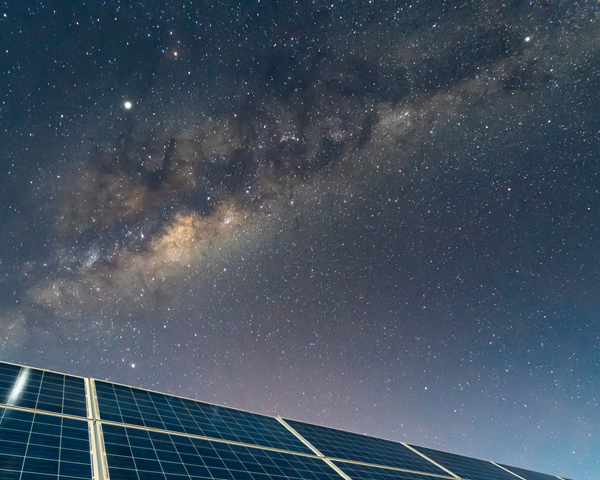
Researchers also suggest system could resolve problems with irregular and weather-dependent Earth-based supply
Solar panels in space could cut Europe’s terrestrial renewable energy needs by 80% by 2050, a study has found.
Using a detailed computer model of the continent’s future power grid, the researchers found that a system of space-based panels designed by Nasa could reduce the cost of the whole European power system by as much as 15%. It could also cut battery use by more than two-thirds.
The study, led by researchers at King’s College London, is the first to assess the possible impact of space solar energy on Europe. The space-based solar power (SBSP) panels that yielded the positive results uses a heliostat design. The design, which the system imitates, uses mirror-like reflectors to collect sunlight in orbit. The sunlight is then transmitted to stations on Earth and converted to electricity before it is delivered to an energy grid.
The computer model of the continent’s power grid spans 33 countries, and simulates electricity demand, generation and storage to identify the lowest-cost option to meet Europe’s electricity needs.
When the researchers integrated the SBSP concept into the model based on Nasa’s predictions of its potential energy capacity, results showed that it could replace as much as 80% of Europe’s land-based renewable energy.
Land-based renewable energy is irregular and weather-dependent, complicating reliable supply, and comes at varying costs, the researchers point out. SBSPs could be an alternative centralised energy resource that operates above the atmosphere with continuous gigawatt-scale power.
The authors note that the modelling does not account for potential impacts from space-specific challenges such as orbital congestion, transmission interruptions or beaming variability, which could influence SBSP reliability and operational performance.
Nor could the potential cost-effectiveness of SBSP be realised until 2050 because building, launching and maintaining it would be too expensive unless technological growth reduces its costs.
Dr Wei He, a senior lecturer at KCL’s engineering department and lead author of the study, which is published in Joule, said: “There are some risks to consider, such as how the satellite in space could have too many solar panels. Could it cause collisions or be damaged by debris in space?”
Despite those risks, Wei believes the research shows that SBSP has the potential to help countries in achieving net zero. “Renewable energy to replace fossil fuels is the most important action we are taking as humans. Space-based solar power is a potential technology and can provide continuous solar power as a renewable energy source,” he said.
The planet’s most important stories. Get all the week’s environment news – the good, the bad and the essential
Europe could follow suit, the paper suggests, mentioning the continent’s longstanding tradition of multinational cooperation of cross-border electricity exchange and satellite ventures under the European Space Agency.
The authors believe Europe could leverage its multinational cooperation to develop and operate a centralised SBSP infrastructure. In doing so, it could create a continent-scale solution to provide stable, baseload-scale renewable supply, reducing the continent’s reliance on gas-fired power.
“Now is the time,” Wei said.
We know, we know, we know …
Seeing these messages is annoying. We know that. (Imagine what it’s like writing them … )
But it’s also extremely important. One of the Guardian’s greatest assets is its reader-funded model.
1. Reader funding means we can cover what we like. We’re not beholden to the political whims of a billionaire owner. No one can tell us what not to say or what not to report.
2. Reader funding means we don’t have to chase clicks and traffic. We’re not desperately seeking your attention for its own sake: we pursue the stories that our editorial team deems important, and believe are worthy of your time.
3. Reader funding means we can keep our website open, allowing as many people as possible to read quality journalism from around the world – especially people who live in places where the free press is in peril.
The support of readers like you in Egypt keeps all that possible. At the moment, just 2.4% of our regular readers help fund our work. If you want to protect independent journalism, please consider joining them today.
We value whatever you can spare, but supporting on a monthly basis makes the most impact, enabling greater investment in our most crucial, fearless journalism. As our thanks to you, we can offer you some great benefits. (Including making these messages go away.) We’ve made it very quick to set up, so we hope you’ll consider it. Thank you.