
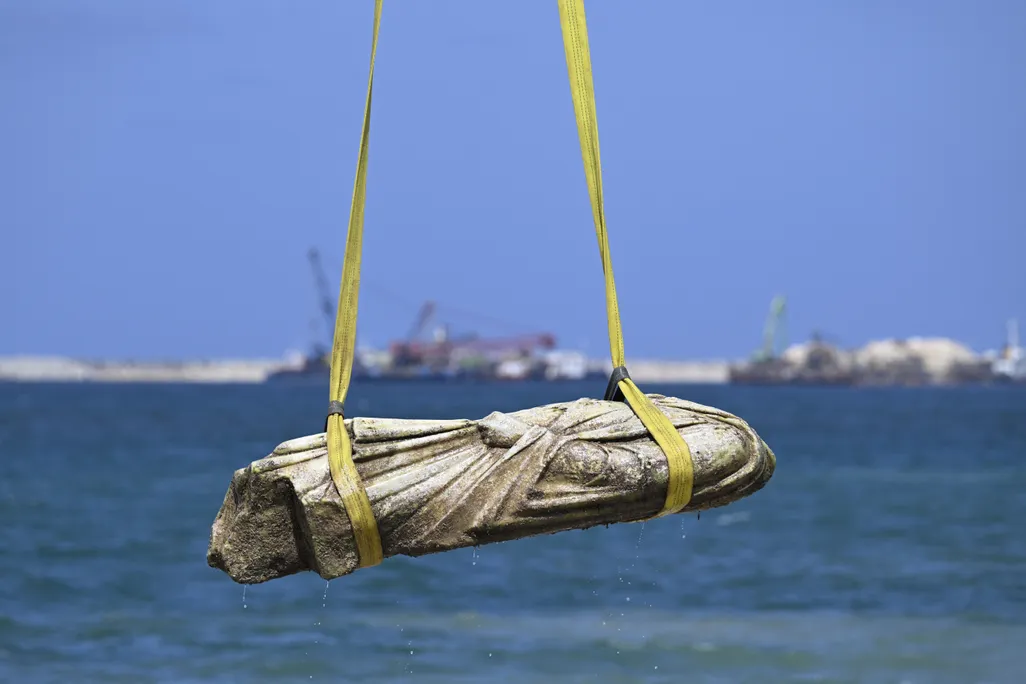
Several large sculptures were among the trove of artifacts that divers recovered from the waters near Alexandria, Egypt. Officials say the site may have been an extension of the nearby city of Canopus
A trove of ancient statues, coins, pottery and pieces of a merchant ship has surfaced from the waters off the coast of Alexandria, Egypt.
As reporters looked on, divers in wetsuits carefully identified the artifacts at the bottom of Abu Qir Bay on August 22. Large cranes hoisted the objects into the air and carried them safely to the shore.
“There’s a lot underwater, but what we’re able to bring up is limited; it’s only specific material according to strict criteria,” Sherif Fathi, Egypt’s tourism and antiquities minister, tells Agence France-Presse. “The rest will remain part of our sunken heritage.”
Officials say the area may have been an extension of Canopus, an ancient city near Alexandria. The items date to Egypt’s Ptolemaic dynasty, which lasted from 305 to 30 B.C.E., and the Roman period, which ended in 642 C.E. The artifacts provide new evidence that the area was “prosperous and developing” during this era, Mohamed Ismail, secretary-general of Egypt’s Supreme Council of Antiquities, tells Reuters.
How, then, did these objects end up at the bottom of the Mediterranean Sea? Historians think that rising sea levels and earthquakes flooded Canopus—along with the nearby port city of Thonis-Heracleion—about 1,200 years ago. The city’s ruins have been submerged ever since.
During the recovery, divers salvaged several large statues, though many were badly damaged. The team unearthed a granite likeness of an unknown Ptolemaic individual, which was missing a head, and the bottom half of a white marble sculpture of a Roman elite. Another statue, which depicts a sphinx, features the cartouche of Ramses II, who ruled from 1279 to 1213 B.C.E.—the second-longest reign in ancient Egyptian history.
Other discoveries included pottery, coins and reservoirs that were used for storing water and raising fish, according to a statement from Egypt’s Ministry of Tourism and Antiquities. Additionally, divers recovered pieces from limestone buildings that may have been homes, businesses or places of worship.
The excavation also revealed fragments of a merchant ship that had been carrying almonds, walnuts and a copper measuring scale. Stone anchors were found nearby, and officials think the site once served as a harbor for small boats.
However, the team left some of these items, including the anchors, beneath the surface of the bay. The recovery effort is the first underwater excavation in Egypt since UNESCO’s Convention on the Protection of Underwater Cultural Heritage in 2001, which established additional protections for underwater artifacts, per Interesting Engineering’s Kaif Shaikh.
Meanwhile, experts worry that Alexandria will be the next victim of climate change and increasing sea levels. The city is already suffering from coastal erosion and ground subsidence due to the rising waters of the Mediterranean, and experts predict these threats will only worsen.
“Alexandria, the city of Alexander the Great, is one of the first great historical cities to begin partially collapsing in modern history under the effects of climate change,” Sara Fouad, a coastal landscape expert at the Technical University of Munich, and Essam Heggy, a planetary scientist at the University of Southern California, told El País’ Marc Español earlier this year. “And it is probable that the pace of its collapse will increase notably if measures of mitigation are not soon adopted.”
Since the artifacts were recovered from Abu Qir Bay, experts have been working to restore them. The trove will eventually go on display as part of “Secrets of the Sunken City,” an exhibition that opened at the Alexandria National Museum earlier this month. The show, which features 86 items, focuses on archaeological discoveries from the Ptolemaic and Roman eras.