
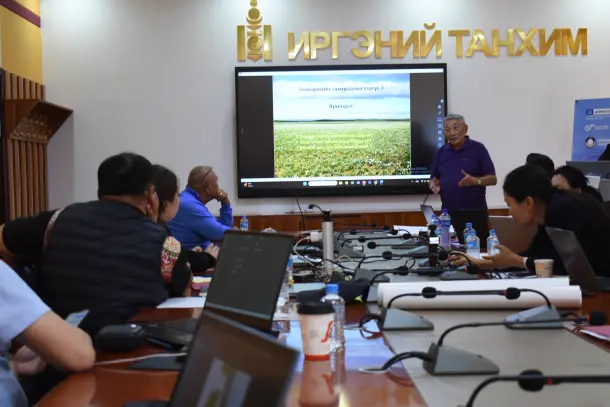
As part of the “Promoting Sustainable Tourism in Mongolia through UNESCO Cultural and Geo Heritage” project, supported by Rio Tinto Mongolia LLC, the UNESCO Regional Office for East Asia conducted a series of capacity-building initiatives from 27 September to 4 October 2025 in Khanbogd soum, Umnugovi province, in partnership with the Governor’s Office of Khanbogd soum. The series included a media field visit, and three workshops: for guides and heritage interpreters, for handicrafts development, and for the Geopark Preliminary Management Team. Together, these initiatives supported local actors in developing the skills and tools needed to connect Mongolia’s unique natural, cultural, and geo heritage with sustainable tourism and economic opportunities.
The on-site activities kicked off with a field visit by journalists, social media influencers, and communication officers following their Media Training on Environment, Climate, Heritage, and Sustainable Tourism Reporting held in Ulaanbaatar on 25-26 September 2025. Co-organized by UNESCO and the Press Institute of Mongolia, the programme equipped the participants with tools for reframing climate narratives, ensuring access to reliable environmental and heritage information, and promoting solutions-oriented reporting. The field visit further strengthened their skills by providing opportunities for on-the-ground journalism and reporting.

The first of the workshops focused on enhancing guiding and interpretation skills for local community members interested in the tourism sector. Twenty-seven participants from Khanbogd and Manlai soums took part in the two-day workshop. The facilitators, Dr. Munkhbadral Batsukh, Dr. Tsolmon Sodnom, and Ms. Catherine Germier-Hamel, covered various topics such as the difference between guiding and heritage interpretation, the role of storytelling in tourism, and how to design meaningful, community-based itineraries that highlight local history, traditions, and landscapes.
Through hands-on exercises, the participants practiced identifying and interpreting both tangible and intangible cultural heritage elements. They developed storytelling techniques and designed potential tour routes incorporating their new knowledge. By the end of the workshop, the participants expressed increased confidence and a stronger sense of ownership over their local heritage as a foundation for sustainable tourism.
Afterwards, a three-day workshop brought together 24 participants from Khanbogd and Manlai soums to explore creative approaches to handicraft development from 1 to 3 October 2025. The training, facilitated by Dr. Batsaikhan Tseyen-Oidov, Mr. Batbayar U., Ms. Saruul Arslan, and Dr. Enkhbat Galbadrakh, provided the participants with insights into product design, branding, intellectual property, and the use of local cultural and natural motifs to strengthen product identity. The participants learned about sustainable design, online marketing, and how to create brand books for their businesses.

With one-on-one mentoring from the design and marketing experts, the participants developed unique brand logos, slogans, and product ideas inspired by the Gobi’s rich heritage, including motifs from dinosaur tracks, camel culture, and local monasteries. By the end of the workshop, several participants had developed new brand ideas for handmade clothing, leather goods, candles, and artisanal food products. The workshop not only nurtured creative entrepreneurship but also emphasized the potential of handicrafts as a vehicle for preserving and sharing the Gobi region’s identity while generating sustainable livelihoods.
To further strengthen local capacity for long-term heritage management, UNESCO also organized a two-day workshop on 2-3 October 2025 for the members of the Geopark Preliminary Management Team and key stakeholders in collaboration with the Institute of Geography and Geoecology of the Mongolian Academy of Sciences. The training provided exposure to international good practices from established UNESCO Global Geoparks and focused on discussing a draft roadmap for establishing an aspiring geopark in Umnugovi province. The participants learned from case studies from China, Greece, and Chile, and discussed methodologies for assessing geosite suitability and developing management plans, setting the groundwork for sustainable governance of the region’s geological and cultural resources.

These workshops collectively mark an important milestone in empowering local communities in Khanbogd and Manlai soums to play a central role in shaping the future of tourism and heritage preservation in Mongolia’s Gobi region. By investing in local skills and strengthening collaboration between communities, government, and experts, UNESCO’s initiative helps ensure that the Gobi’s unique landscapes, cultural traditions, and geological treasures are safeguarded and celebrated as part of a sustainable and inclusive tourism future.